Why Utility Trailers Remain the Backbone of Small‑Business Logistics in 2026
Utility trailers have long been the workhorse of contractors, landscapers, and hobbyists who need a versatile, low‑cost platform for hauling equipment, building materials, and personal gear. Our data shows that despite a modest decline in overall listings, the average new‑sale price sits at $3,578, and demand remains solid across the nation’s thousands of dealers. In a market where construction spending tops $1.3 trillion and freight volumes exceed 11 billion tons, utility trailers continue to capture a reliable slice of the logistics pie.
In this deep‑dive we outline everything a dealer needs to know to maximize profit on utility trailers in 2026: specifications, pricing tiers, top manufacturers, buyer demographics, common uses, profit margins, best‑selling configurations, and the accessories that turn a simple trailer into a high‑margin upsell opportunity. We also show how Trailer Shopper® AI can automate inventory syndication, generate video‑first listings, and keep your lead pipeline humming.
Market Snapshot: Macro Forces Shaping Utility Trailer Sales
Several macro‑economic factors are influencing buyer behavior this year:
- GDP growth of 2.2% keeps commercial activity steady, supporting demand for light‑duty hauling solutions.
- Inflation remains low at 2.3%, allowing buyers to stretch budgets for higher‑quality steel or aluminum units.
- Interest rates hovering between 4.5% and 5.5% mean financing costs are manageable for small‑business owners.
- Unemployment at 3.6% fuels a robust labor market, translating into more contractors who need utility trailers for daily jobs.
These conditions produce a “moderate growth” environment for utility trailers, where price sensitivity is balanced by a willingness to pay a premium for durability, weight savings, and technology.
Specifying the Utility Trailer: Sizes, GVWR, and Material Choices
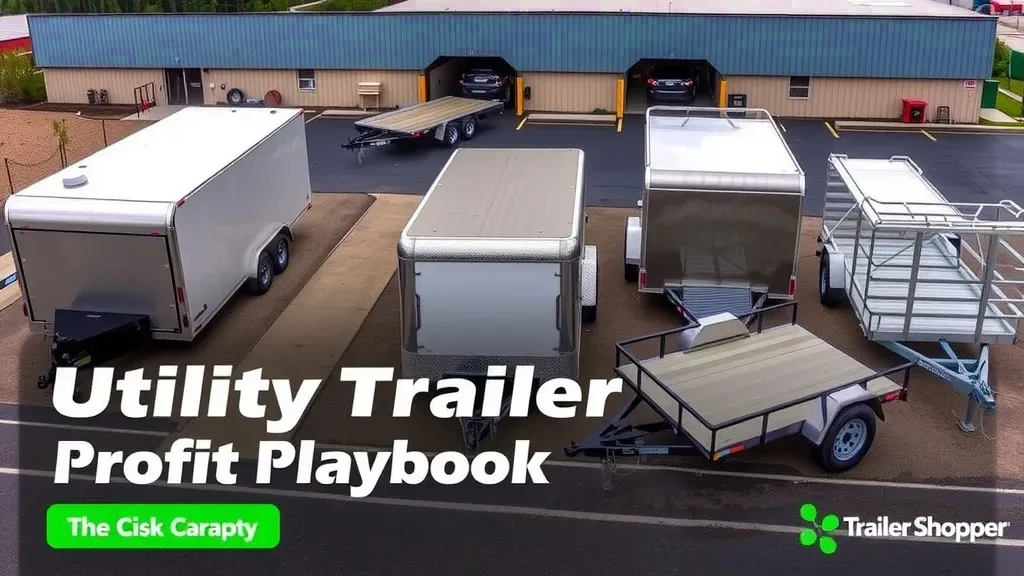
Utility trailers come in a range of dimensions that cater to distinct use‑cases. The most popular footprints in 2026 are:
- 5 × 8 ft – ideal for garden tools, small‑scale landscaping, and hobbyist gear.
- 6 × 10 ft – the work‑horse size for contractors hauling ladders, drywall, and light equipment.
- 7 × 14 ft – a larger platform for bulk material moves, small‑scale demolition, and equipment transport.
Gross Vehicle Weight Ratings (GVWR) typically range from 2,000 lb to 7,000 lb, with steel‑frame models on the heavier end and aluminum‑frame units offering a 10‑20% weight reduction. The material split remains steady at 70% steel, 30% aluminum. While steel delivers rugged durability at a lower base cost, aluminum commands a price premium of 10‑15% and enjoys a resale advantage of 5‑10% due to its lighter weight and corrosion resistance.
Pricing Tiers and Margin Strategies
Our pricing intelligence recommends a market‑based markup of 10‑15% above cost. Dealers can use the following tiered approach:
- Entry‑Level Steel Units: Cost $3,100 → List $3,410‑$3,565 (ends in .99 or .95 for perceived value).
- Mid‑Range Steel with Upgraded Axles: Cost $3,300 → List $3,630‑$3,795.
- Premium Aluminum Models: Cost $3,500 → List $3,850‑$4,025 (reflects 10‑15% material premium).
- Electric‑Ready / Telematics‑Enabled: Cost $3,850 → List $4,235‑$4,430 (adds a 10% cost premium for the technology package).
Psychological pricing tips from our data include ending prices in .99 or .95 and using anchoring – display a higher‑priced “deluxe” model next to the mid‑range unit to make the latter appear more reasonable.
When it comes to trade‑ins, offering a competitive value based on the trailer’s age, condition, and market demand can accelerate turnover. Our platform’s CRM Pipeline and Trade‑In modules let dealers quickly generate quotes and capture the customer’s existing equipment details.
Top Manufacturers and Model Highlights
While the market is fragmented, a handful of manufacturers dominate the utility segment. Dealers who stock these brands consistently see higher sell‑through rates:
- Haulmark – Known for rugged steel frames, dual‑axle options, and a broad dealer network.
- Continental Cargo – Offers a balanced portfolio of steel and aluminum units, with a reputation for easy‑to‑service components.
- Pace American – Strong in the mid‑range market, especially 6 × 10 and 7 × 14 configurations.
- Look Trailers – The go‑to for aluminum utility trailers, prized for weight savings and a clean aesthetic.
- Custom‑Built Local Fabricators – Provide niche features such as integrated toolboxes, fold‑down ramps, and specialty lighting.
Dealers should highlight each manufacturer’s unique selling proposition in listings. Using Trailer Shopper® AI’s AI Presenter, you can generate a short video that showcases the build quality, material differences, and key accessories—all without a studio crew.
Buyer Demographics: Who Is Buying Utility Trailers in 2026?
Understanding the buyer helps you tailor marketing and inventory decisions:
- Independent Contractors (45%) – Small‑scale builders, landscapers, and handymen who need a reliable platform for daily jobs.
- Recreational Users (30%) – Outdoor enthusiasts hauling ATVs, kayaks, or camping gear.
- Small Business Owners (15%) – Retailers, mobile service providers, and pop‑up vendors needing a portable storefront.
- Fleet Managers (10%) – Companies that supplement larger semi‑truck fleets with light‑duty utility trailers for “last‑mile” deliveries.
These groups value durability, ease of loading, and low operating costs. The rise of telematics (20% of new sales) is especially appealing to fleet managers who want real‑time location and load data.
Common Use Cases and Revenue‑Generating Scenarios
Utility trailers are the most adaptable class in the trailer market. Typical applications include:
- Transporting landscaping tools, lumber, and drywall.
- Moving small equipment for HVAC, electrical, or plumbing jobs.
- Hauling recreational gear such as ATVs, jet‑skis, and camping equipment.
- Serving as a mobile workshop with built‑in toolboxes and workbenches.
- Providing a “pop‑up” retail space for seasonal vendors.
Dealers can position these use cases in their listings, pairing the trailer with relevant accessories to increase average order value.
Profit Margins: From Cost to Cash
When you apply a 12% average markup on a $3,300 cost, the gross profit per unit is roughly $396. Adding high‑margin accessories—ranging from $150 to $500—can push total profit per sale above $800. The key is bundling: a well‑priced accessory package (e.g., LED lighting + tool box + spare tire) often sells at a combined markup of 20‑30%.
Our Analytics Dashboard lets dealers track per‑unit profitability in real time, flagging which accessories generate the highest ROI. Coupled with the Smart Messaging feature, you can automatically suggest relevant add‑ons when a buyer views a specific trailer size.
Best‑Selling Configurations in 2026
Based on national sales velocity, the following configurations consistently outperform the rest:
- 6 × 10 ft steel frame with dual‑axle – Ideal for contractors; average sell‑through time under 45 days.
- 5 × 8 ft aluminum with fold‑down ramp – Popular with recreational buyers seeking easy loading.
- 7 × 14 ft steel with integrated tool box – Preferred by small business owners needing a mobile workshop.
- Electric‑ready 6 × 10 ft with telematics – Growing niche; 5% of new sales but higher average price and profit margin.
Dealers should keep these models in the front of their inventory feed and prioritize them in AI‑generated landing pages that rank high in search results.
High‑Margin Accessories to Upsell
Accessories are the true profit engine for utility trailers. Below are the top five upsell candidates, along with typical markup ranges:
- LED Lighting Kit – Improves night‑time visibility; cost $45, list $85 (≈ 89% markup).
- Heavy‑Duty Tool Box – Steel or aluminum, lockable; cost $120, list $210 (≈ 75% markup).
- Spare Tire & Wheel Set – Essential for on‑site repairs; cost $80, list $150 (≈ 88% markup).
- Integrated Ramp (Fold‑Down or Removable) – Facilitates loading; cost $150, list $275 (≈ 83% markup).
- Telematics Module – GPS, load sensors, and maintenance alerts; cost $250, list $425 (≈ 70% markup).
When you bundle two or more accessories, you can apply a “bundle discount” while still maintaining a healthy overall margin. Trailer Shopper® AI’s post‑quantum encryption ensures that bundle pricing data remains secure across all syndication channels.
Electric and Telematics Adoption: A Growing Sub‑Segment
Electric‑ready utility trailers now represent 5% of new sales, and telematics units account for 20%. While the upfront cost premium is roughly 10% higher than traditional models, dealers can justify the price with lower operating costs, future‑proofing, and the ability to market to eco‑conscious buyers.
Dealer readiness is improving: 60% of dealers already have electric or telematics‑enabled inventory. For the remaining 40%, we recommend a phased rollout—start with a single electric‑ready 6 × 10 ft model, promote it heavily using AI Video Commercials, and gauge local demand before expanding the line.
Inventory Management, Markdown Schedules, and Wholesale Triggers
Our platform’s Inventory Management module automates the markdown cadence recommended for utility trailers:
- Initial price holds for 30 days.
- Automatic 5% markdown at day 30 if unsold.
- Second 5% markdown at day 60.
- After 120 days, the system flags the unit for wholesale or dealer‑to‑dealer transfer.
These rules keep your lot fresh and prevent capital from being tied up in stale inventory. The Heatmap Analytics feature visualizes which units are languishing, allowing you to intervene with targeted promotions.
Leveraging Trailer Shopper® AI for Maximum Reach
In a fragmented digital landscape, the ability to push inventory to multiple channels with a single click is a competitive advantage. Trailer Shopper® AI offers:
- One‑click syndication to Facebook Marketplace, Instagram, TikTok, and major classifieds.
- AI‑generated video listings using the AI Presenter, turning a static photo into a dynamic sales pitch.
- A unified inbox that aggregates messages from every platform, with AI‑driven reply suggestions to accelerate response times.
- Automated ad creation across six ad networks, letting you scale spend without juggling separate dashboards.
Dealers who adopt these tools see a 30‑40% increase in qualified leads and a reduction in the time‑to‑sale for utility trailers.
Marketing Materials: From Banners to Branded Apparel
Beyond digital, our in‑house production facilities can supply high‑impact physical marketing assets:
- Custom‑printed banners featuring your dealership’s logo and featured utility trailer models.
- Durable bow flags for lot signage, increasing on‑site visibility.
- Professional brochures that pair product specs with QR codes linking directly to your AI‑generated landing pages.
- Branded apparel—work shirts and caps—that reinforce brand recall among field crews and customers.
These assets integrate seamlessly with the White‑Label Portal, allowing you to download print‑ready files or order directly through our dealer portal.
Actionable Checklist for Dealers
"The most profitable utility trailer inventory is the one that moves fast, sells with accessories, and is backed by data‑driven pricing." – Trailer Shopper® Intelligence Desk
- Audit current inventory: Identify steel vs. aluminum mix; aim for a 70/30 split.
- Apply a 10‑15% market‑based markup; end prices in .99 or .95.
- Introduce at least one electric‑ready or telematics‑enabled model.
- Bundle high‑margin accessories (LED lights, tool boxes, spare tires) and price the bundle 5‑10% below the sum of individual parts.
- Use Trailer Shopper® AI to create video listings for each top‑selling configuration.
- Schedule automatic syndication to Facebook Marketplace, Instagram, and classified sites.
- Set up the markdown schedule: 30‑day and 60‑day price reductions; trigger wholesale after 120 days.
- Leverage the CRM Pipeline to capture trade‑in offers and follow up with personalized email sequences.
- Order physical marketing collateral (banners, brochures, apparel) through the dealer portal to reinforce brand presence on the lot.
- Monitor performance via the Analytics Dashboard and adjust pricing or accessory bundles based on real‑time data.
Conclusion: Positioning Your Dealership for Utility Trailer Success
Utility trailers remain a cornerstone of the light‑duty hauling market in 2026. By aligning inventory with the proven pricing tiers, emphasizing high‑margin accessories, and embracing emerging technologies such as electric powertrains and telematics, dealers can capture healthy profit margins while meeting evolving buyer expectations.
When you pair these strategies with the integrated capabilities of Trailer Shopper®—from AI‑driven video listings to unified lead management—you eliminate the friction of juggling multiple tools and focus on what matters: moving more trailers, faster, and at higher profitability.
— Trailer Shopper Intelligence Desk