Executive Summary
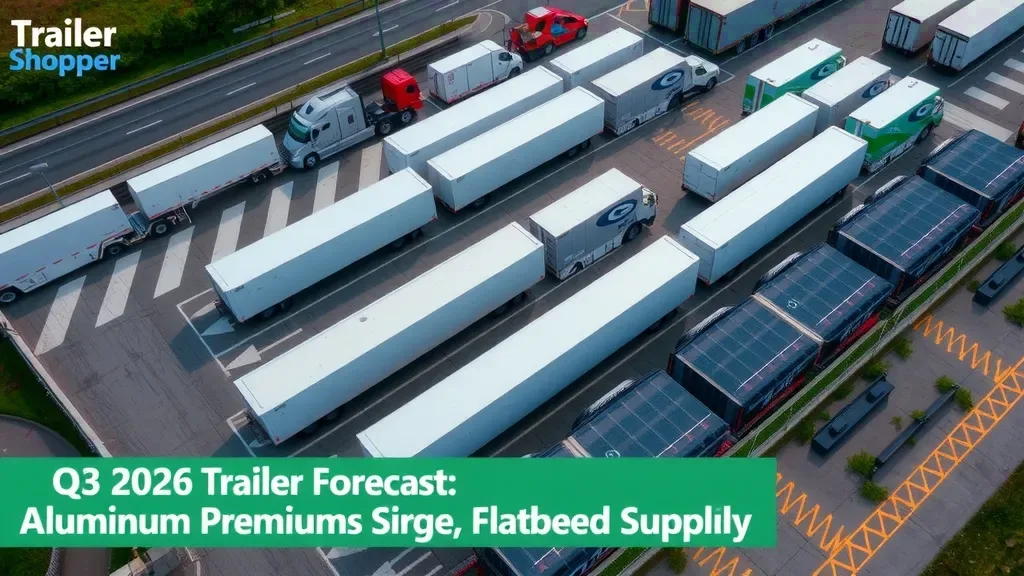
We have compiled the latest intelligence from our national dealer network to deliver a comprehensive Q3 2026 trailer industry forecast. The data points to a clear divergence between material segments: aluminum‑based utility and specialty trailers are enjoying a 10‑20% price premium and a 5‑10% resale advantage, while flatbed and utility inventories are increasingly saturated, pressuring margins. Steel prices remain elevated, and supply‑chain disruptions continue to shape production timelines. Dealers who align pricing with market‑based markup strategies, leverage psychological pricing cues, and adopt Trailer Shopper® AI‑driven marketing and inventory tools will be best positioned to capture growth while mitigating risk.
Demand Outlook: Where Buyers Are Focusing Their Dollars
Our analytics show three distinct demand currents shaping the Q3 landscape:
- Aluminum‑dominant segments – Utility, cargo, RV, horse, and boat trailers are seeing a shift toward lighter‑weight aluminum construction. Buyers cite 10‑20% weight savings as a primary factor for fuel‑efficiency and payload optimization.
- Commercial‑semi steel demand – Heavy‑duty commercial semi‑trailers continue to favor steel, driven by durability requirements and fleet‑owner confidence in long‑term service life.
- Flatbed and open‑utility saturation – Both categories are experiencing a supply glut, with inventory aging beyond the 45‑60 day “new” window and 60‑90 day “used” window. This excess is prompting dealers to adopt aggressive markdowns after the 30‑day (new) and 60‑day (used) thresholds.
Overall, the market is buoyed by robust freight volumes linked to e‑commerce growth, while agricultural and construction‑related demand remains muted due to variable output and reduced spending, respectively.
Pricing Predictions: Premiums, Markups, and Psychological Levers
Our pricing model, which applies a 10‑15% market‑based markup to cost, remains the benchmark for profitability. However, the aluminum premium is reshaping the price architecture:
- Aluminum trailers command a 10‑20% price premium over comparable steel models.
- Dealers who end prices in .99 or .95 are seeing a perceived value lift of up to 3% in conversion rates.
- Anchoring higher‑priced flagship models (e.g., premium enclosed cargo units) raises the perceived affordability of mid‑tier inventory.
Trade‑in strategies are also evolving. Offering competitive trade‑in values based on current market benchmarks—rather than flat percentages—has proven to accelerate turnover, especially in the flatbed segment where inventory is aging.
Supply Chain Status: Steel, Aluminum, and Production Capacity
The steel market continues to feel the pressure of global demand spikes. Since February 2026, steel prices have risen sharply, a trend that is expected to linger as geopolitical factors and raw‑material bottlenecks persist. Aluminum, while still more affordable than steel on a per‑pound basis, is seeing increased adoption that is gradually tightening its own supply chain.
Manufacturers are responding with capacity expansions. Notably, Great Dane’s new Georgia facility, announced in June 2026, adds significant dry‑van production capability, aimed at satisfying the growing demand for aluminum‑based cargo solutions. Yet, the broader industry still reports delays in key components—axles, brakes, and lighting—extending lead times for both new and refurbished units.
Dealers should anticipate a 5‑10% increase in production lead times for steel‑dominant models and a similar, if slightly lower, lag for aluminum units as manufacturers balance raw‑material allocation.
Growth Areas: Where the Market Is Expanding
Three segments stand out as growth engines for the remainder of 2026:
- Aluminum utility and specialty trailers – Light‑weight benefits are driving adoption among small‑business owners, RV enthusiasts, and equine operators. The resale advantage of 5‑10% further fuels secondary‑market activity.
- Electronic integration and smart‑towing accessories – Dealers offering bundled telematics, brake‑assist systems, and AI‑driven load‑monitoring kits are seeing higher average transaction values.
- Dealer‑produced marketing collateral – Our in‑house production of banners, bow flags, and apparel provides a low‑cost, high‑visibility channel for local brand reinforcement, especially in regions where flatbed oversupply forces price competition.
Investing in these areas aligns with the broader trend toward higher‑margin, value‑added offerings rather than pure volume sales.
Risks: Headwinds That Could Dampen Momentum
While opportunities abound, several risk factors could alter the forecast:
- Continued steel price volatility – Any further spikes could erode profit margins for steel‑heavy segments unless passed through to customers.
- Supply‑chain bottlenecks – Ongoing shortages of critical components may force dealers to carry higher inventory levels, increasing carrying costs.
- Regulatory shifts – Emerging emissions standards for heavy‑duty fleets could accelerate the shift toward lighter aluminum units, but also introduce compliance costs for manufacturers.
- Economic slowdown – A dip in construction spending or agricultural output would further suppress demand for utility and flatbed trailers.
Dealers who monitor these variables closely and adjust inventory mix proactively will be better insulated.
Opportunities for Dealers: Strategic Actions to Capture Value
Based on our data, we recommend the following tactical moves:
- Re‑balance inventory toward aluminum – Prioritize stocking lightweight utility and specialty units to capture the premium and resale advantage.
- Implement market‑based pricing with psychological cues – Apply a 10‑15% markup, end prices in .99, and use anchoring to lift perceived value.
- Accelerate turnover of flatbed and open‑utility stock – Leverage the 30‑day new‑item and 60‑day used‑item markdown schedule, and consider wholesale triggers after 90‑120 days to free capital.
- Leverage Trailer Shopper® AI for omnichannel reach – Use the AI Presenter to create video tours of inventory, syndicate posts to Facebook Marketplace, social networks, and classifieds with a single click, and manage all inbound inquiries through the unified inbox.
- Bundle smart accessories – Offer telematics, brake‑assist, and load‑monitoring kits as part of a “tech‑enhanced” package, increasing average sale price.
- Deploy in‑house marketing collateral – Order custom banners, bow flags, and brochures through our factory‑direct service to reinforce local brand presence without third‑party spend.
- Utilize Trailer Shopper® analytics – Track heat‑map performance, SEO rankings, and lead conversion metrics from a single dashboard to refine ad spend and inventory decisions.
These actions are designed to improve gross margin, reduce days‑on‑hand, and enhance brand visibility across the fragmented trailer marketplace.
How Trailer Shopper® Empowers Dealers in Q3 2026
Our platform is built to be the single source of truth for dealer inventory, customers, and data. By consolidating all functions under one roof, dealers can:
- Post‑quantum encrypted listings – Secure data at rest and in transit, protecting both dealer and buyer information.
- Generate AI‑driven video commercials – The AI Presenter records a dealer‑styled walkthrough, automatically edited and ready for syndication.
- Syndicate inventory to ten external platforms – One‑click distribution to Facebook Marketplace, Instagram, TikTok, and major classifieds expands reach without extra tools.
- Manage all leads in a unified inbox – AI replies handle routine questions, freeing staff to focus on high‑value interactions.
- Run multi‑network ad campaigns – Six ad networks are accessible from a single dashboard, enabling precise budget control.
- Access a full suite of marketing assets – From banners to apparel, our factory‑direct production ensures consistent branding at dealer‑friendly pricing.
When dealers adopt these capabilities, they reduce operational overhead, increase marketing efficiency, and retain full ownership of their customer data—a competitive advantage that traditional, fragmented solutions cannot match.
Conclusion: Navigating Q3 with Data‑Driven Confidence
Q3 2026 presents a mixed picture: aluminum’s premium and resale strength open high‑margin avenues, while flatbed oversupply forces price discipline. Supply‑chain volatility and steel price pressure remain the primary headwinds, but strategic inventory rebalancing, market‑based pricing, and the full leverage of Trailer Shopper® AI and marketing services can turn challenges into profit‑center opportunities.
Dealers who act now—optimizing mix, embracing technology, and capitalizing on our in‑house promotional capabilities—will emerge from the quarter with stronger cash flow, higher turnover, and a fortified brand position for the remainder of the year.
— Trailer Shopper Intelligence Desk