Why Understanding the Online Marketplace Matters Today
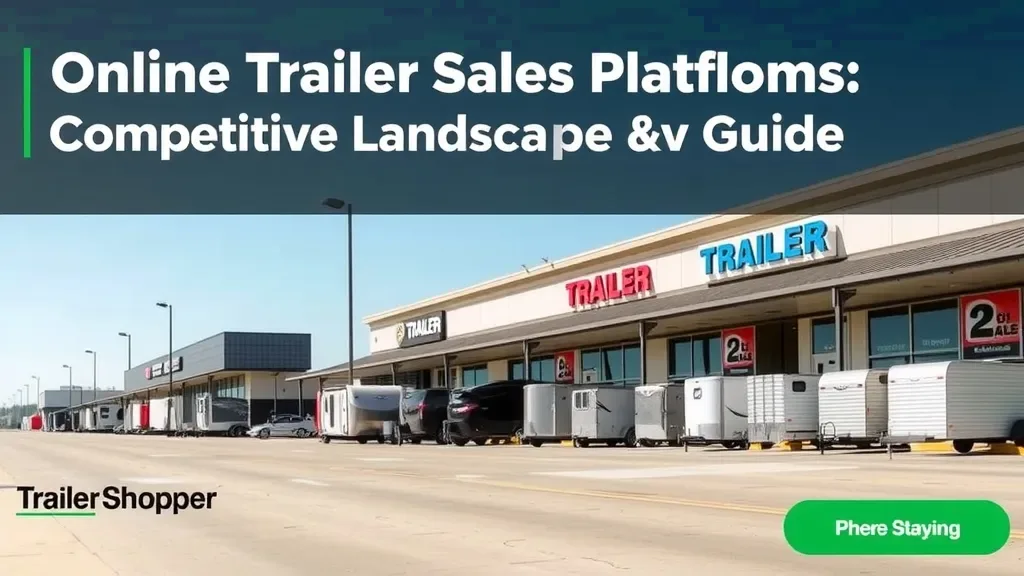
In 2026 the average trailer listing price sits at $12,296. With that figure in mind, every dealer’s decision about where to display inventory directly impacts gross margin, lead cost, and days‑on‑lot. Our national network of thousands of dealers has compiled a data‑driven snapshot of the online landscape, allowing you to compare platforms on the same metrics that drive profitability.
Platform Categories – The Four Main Archetypes
Rather than focusing on brand names, we group the ecosystem into four functional categories. Each category serves a distinct buyer intent and comes with its own cost structure, traffic volume, and operational trade‑offs.
- Free Classified Networks – Open‑access sites that attract the broadest local audience but provide minimal lead qualification.
- Subscription‑Based Trailer Marketplaces – Dedicated portals that charge a flat monthly fee for unlimited listings and often add premium tools such as financing leads.
- Auction‑Centric Platforms – Marketplaces that operate on a commission‑per‑sale model, delivering verified condition reports and attracting fleet buyers.
- Dealer‑Management & CRM Suites – Integrated software that bundles inventory management, customer relationship tools, and marketing automation under a single subscription.
Free Classified Networks – Reach at a Cost
Free classified sites dominate local search traffic. Their primary advantage is zero listing fees and a very broad audience that includes casual buyers, renters, and hobbyists. However, the data shows a consistent pattern of low‑quality leads and high spam volume. Dealers retain full control over post content, but the lack of SEO value for the dealer’s own website limits long‑term brand equity.
Key metrics
- Lead quality: low
- Reach: Local, very broad audience
- Data control: High – dealers own the post and direct messages
- SEO impact: Minimal for dealer sites
- Typical cost per lead: $75‑$125 (derived from industry averages)
Because the platform is free, many dealers post multiple times to increase visibility, but the resulting noise can dilute brand perception. For independent dealers who rely on personal relationships, the low cost can be justified, yet the conversion rate hovers around 18‑25%, meaning a sizable portion of effort does not translate into sales.
Subscription‑Based Trailer Marketplaces – The Dedicated Audience
Dedicated trailer portals attract buyers who are already researching specific categories—cargo, utility, horse, or equipment trailers. Monthly traffic estimates range from 500,000 to 1,000,000 unique visits, providing a sizable pool of qualified prospects.
Strengths
- High traffic volume (up to 1M visits per month)
- Focused buyer intent – users are actively searching for trailers, not general classifieds
- Free listings on some platforms reduce upfront spend
- Customer reviews and rating systems help build dealer credibility
Weaknesses
- Limited direct customer support – most platforms rely on automated help desks
- Flat‑fee models can become costly for high‑volume dealers
- Data ownership often remains with the platform, making it harder to export leads into a dealer’s own CRM
When a dealer pays a subscription of $99‑$199 per month, the cost per lead can drop to the $30‑$60 range, dramatically improving the return on ad spend (ROAS). However, the trade‑off is that the dealer’s inventory lives inside the third‑party system, requiring manual export or API integration to keep a master “source of truth.”
Auction‑Centric Platforms – High‑Value Fleet Buyers
Auction sites specialize in bulk sales, fleet turnover, and commercial equipment. Their traffic is smaller—estimated at 500,000+ monthly visits—but the buyer profile is markedly different: businesses looking for verified condition reports, transparent inspection data, and often ready to purchase in larger quantities.
Strengths
- Verified inspection reports increase buyer confidence
- Access to commercial and fleet customers who can move multiple units quickly
- Commission‑based pricing aligns cost with actual sales (no upfront listing fees)
Weaknesses
- Auction format can deter retail buyers who prefer private sales
- Commission rates (often 5‑10% of sale price) can erode margins on lower‑priced units
- Longer sales cycles for high‑value equipment, potentially extending the average 75‑day on‑lot period
Dealers that specialize in heavy‑duty or specialty trailers—such as dump trucks, low‑boy equipment haulers, or high‑capacity cargo units—often find auction platforms the most efficient route to move inventory quickly, especially when the gross margin on new units ranges from 10‑15% and on used units from 15‑20%.
Dealer‑Management & CRM Suites – The All‑In‑One Approach
Integrated software solutions bundle inventory control, customer relationship management, marketing automation, and sometimes even financing lead generation. Monthly pricing ranges from $100 to $500, with the higher tiers offering API access, Zapier integrations, and advanced analytics.
Core capabilities commonly found
- Inventory management with real‑time stock updates
- CRM pipelines that track leads from inquiry to close
- Automated email and SMS marketing sequences
- Analytics dashboards that surface conversion rates, cost‑per‑lead, and service revenue per unit
These suites excel for dealers with complex inventories—multiple trailer types, parts catalogs, and service departments. The average close rate of 18‑22% reported across the industry aligns well with the feature set, and the ability to keep all data under the dealer’s own domain mitigates the data‑ownership concerns that plague free and subscription platforms.
Choosing the Right Channel – A Decision Framework
Our data suggests that the optimal mix is rarely a single platform. Instead, dealers should evaluate each channel against three strategic pillars: Cost Efficiency, Lead Quality, and Data Ownership.
1. Cost Efficiency
Calculate the effective cost per qualified lead (CPL). For free classifieds, the CPL can exceed $100 when you factor in time spent filtering spam. Subscription portals typically bring CPL down to $30‑$60, while auction commissions hover around $50‑$80 per sale. Dealer‑management suites add a fixed overhead but can reduce CPL through automation and higher conversion rates.
2. Lead Quality
Lead quality is measured by the buyer’s intent and the likelihood of closing. Free classifieds generate a high volume of low‑intent inquiries, while dedicated marketplaces and auction sites deliver buyers who have already filtered out non‑serious prospects. The industry average close rate of 18‑25% improves to 22‑28% when leads come from platforms that require registration or provide inspection reports.
3. Data Ownership
Control over inventory data, lead information, and customer interactions is essential for long‑term growth. Platforms that lock data inside their ecosystem force dealers to rebuild their own CRM or risk losing leads when a subscription lapses. An integrated solution that keeps the dealer’s inventory as the single source of truth—while syndicating to external channels—offers the best balance of reach and control.
How Trailer Shopper® Complements the Landscape
Our platform is built around the principle of one source of truth, many distribution points. While the market offers a patchwork of classifieds, subscription portals, and auction houses, Trailer Shopper® provides a unified hub where dealers can:
- Import inventory once via our Feed Import tool and instantly push it to Facebook Marketplace, social networks, and classified sites with a single click.
- Leverage AI Presenter to create video tours of each trailer—no videographer needed—boosting engagement on every channel.
- Manage all inbound inquiries through a Unified Inbox that aggregates messages from every syndication outlet, powered by AI‑driven reply suggestions.
- Run ads across six major ad networks from a single dashboard, reducing spend and eliminating the need for separate ad accounts.
- Protect data with post‑quantum encryption, ensuring that lead and inventory information never falls into the hands of third‑party data collectors.
Because the dealer’s website, blog, and portal remain under their own domain, the SEO value of every listing stays with the dealer, unlike platforms that isolate listings. Our Analytics Dashboard and Heatmap Analytics give real‑time insight into which listings drive the most clicks, allowing you to reallocate spend instantly.
Strategic Recommendations for 2026
Based on the competitive intel, we recommend a tiered approach:
- Core Presence – Trailer Shopper® Hub: Keep every unit, lead, and customer interaction inside our platform. Use the AI Builder to generate video content and post to all external channels with one action.
- Targeted Paid Reach – Subscription Marketplaces: Allocate a modest budget ($99‑$199/mo) to a high‑traffic dedicated portal for each trailer segment (cargo, utility, horse). The low CPL and focused buyer intent make this a high‑ROI channel.
- High‑Value Bulk Sales – Auction Platforms: For heavy‑duty or fleet inventory, list select units on auction sites where the commission aligns with the higher gross margin on used equipment (15‑20%).
- Local Visibility – Free Classifieds: Maintain a minimal presence on free classifieds to capture walk‑in traffic, but automate the posting process through our Social Posting tool to keep labor costs low.
By layering these channels, dealers can keep the average days on lot well below the industry benchmark of 75 days, improve the close rate to the upper 20s, and protect margins even as external pressures—such as the 5‑15% aluminum tariff—push unit costs upward.
External Market Forces Shaping Platform Choice
Two macro‑level trends directly affect platform strategy:
- Aluminum Tariffs – Current duties of 5% (and a potential rise to 15%) add 3‑10% to trailer manufacturing costs. Dealers who can pass these costs through higher selling prices will need platforms that preserve margin, making low‑CPL, high‑conversion channels essential.
- Used Trailer Value Dynamics – While demand for used units remains strong, inventory aging is becoming a headwind. Dealers must move used stock quickly; auction platforms and high‑intent marketplaces help mitigate the risk of depreciation.
Our own service revenue per unit—ranging from $600‑$1,200 annually for active customers—means that retaining a buyer beyond the initial sale is a critical profitability lever. Platforms that enable ongoing communication (e.g., through our Smart Messaging and CRM Pipeline) give dealers the tools to upsell service contracts, parts, and accessories.
Conclusion – The Future Is Integrated, Not Fragmented
The competitive landscape of online trailer sales is maturing. Free classifieds still dominate raw traffic, but the cost of low‑quality leads erodes profitability. Subscription portals and auction sites offer higher intent at a price, while dealer‑management suites provide the data‑ownership foundation needed for sustainable growth.
Dealers that adopt a single‑source inventory hub—such as Trailer Shopper®—and strategically syndicate to the right mix of external channels will enjoy lower acquisition costs, higher conversion rates, and the ability to protect their data against third‑party tracking scripts. In a market where average margins hover between 10‑15% for new units and up to 20% for used units, the efficiency gains from an integrated platform can be the difference between a profitable quarter and a lost opportunity.
— Trailer Shopper Intelligence Desk