Executive Overview
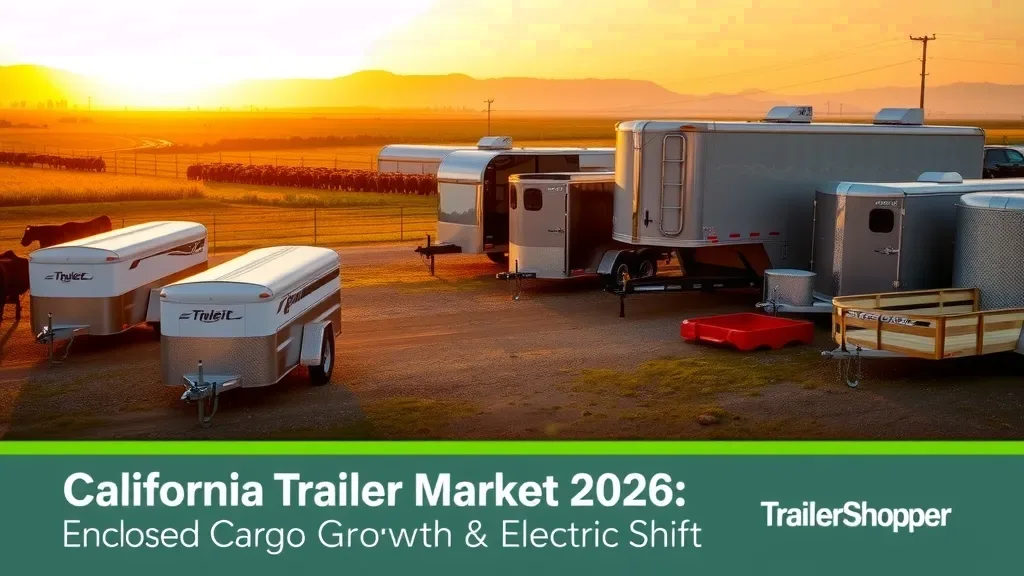
California remains the nation’s most dynamic trailer marketplace. Our intelligence platform shows that the Golden State’s average trailer listing price sits at $12,216, reflecting a blend of premium steel units, a growing aluminum niche, and the early adoption of electric‑powered models. While the national market wrestles with a modest construction slowdown, California’s freight corridors, housing pressure, and progressive emissions policies are generating a distinct demand profile that rewards dealers who can align inventory, pricing, and marketing with these local forces.
Market Size & Pricing Mechanics
In 2026, California’s trailer market is anchored by a 70% steel share and a 30% aluminum share. Aluminum units command a 10‑15% price premium over comparable steel models, translating into higher resale values of 5‑10%. This premium is driven by weight‑savings of 10‑20%, which is especially valuable for the state’s stringent fuel‑efficiency and emissions standards.
Dealers are increasingly employing a market‑based pricing strategy that adds a 10‑15% markup on cost. Psychological pricing tactics—ending prices in .99 or .95 and anchoring higher‑priced models—are proving effective in a market where buyers compare dozens of listings across platforms. Trade‑in programs that offer competitive values are also gaining traction, helping dealers move inventory faster while preserving margins.
Top‑Selling Trailer Types
California’s diverse economy creates pockets of strong demand for specific trailer categories:
- Enclosed cargo trailers dominate the residential moving and small‑business segment. New enclosed units spend an average of 45‑50 days on the lot before markdown, while used units linger 60‑80 days. The markup schedule calls for a price reduction after 30 days for new stock and 60 days for used, with wholesale triggers after 90‑120 days if pricing remains misaligned.
- Open utility trailers remain the workhorse for construction and landscaping firms, though the sector’s overall construction spending has dipped, tempering growth.
- Electric and telematics‑enabled trailers are an emerging niche. Currently, 5% of new trailer sales are electric, and 20% of new sales include telematics packages. Dealer readiness is at 60%, indicating that a majority of California dealers already have at least one electric or telematics‑ready model in inventory.
- Livestock and horse trailers see modest activity, with average prices around $12,174, but the trend is flat to slightly declining as urban sprawl reduces demand for large‑scale animal transport.
Overall, the market’s average listing price of $12,216 is a composite of these segments, with steel‑based utility and open trailers pulling the average downward and premium aluminum enclosed units pushing it upward.
Key Demand Drivers
Three macro‑level forces are shaping California’s trailer demand in 2026:
- Freight Volume Surge: E‑commerce growth and the state’s massive ports have lifted freight volumes to 11.6 billion tons nationally, with California accounting for a disproportionate share. This fuels demand for both utility trailers (last‑mile delivery) and enclosed cargo units (secure transport of high‑value goods).
- Housing Affordability Crisis: Sky‑rocketing home prices and a shortage of affordable housing have spurred a DIY moving market. Homeowners and renters alike rely on mid‑size enclosed trailers (5×10, 6×12) for intra‑city moves, creating a steady stream of buyers seeking affordable, reliable units.
- Environmental Regulations: California’s CARB emissions standards and weight‑limit policies encourage lighter, more fuel‑efficient aluminum trailers and accelerate interest in electric models. Dealers that stock compliant, low‑weight units can command higher prices and enjoy faster turnover.
Regulatory Landscape
California’s regulatory environment is more demanding than most states. Two key areas affect dealer operations:
- CARB Emissions & Weight Limits: The California Air Resources Board mandates stricter emissions thresholds for diesel‑powered trailers and enforces weight‑to‑axle limits that favor lighter aluminum constructions. Non‑compliant units face penalties and reduced resale value.
- DOT 49 CFR 571.108 (Brake Standards): Updated in 2020, this federal rule requires all trailers sold in California to meet enhanced brake performance criteria. Dealers must verify compliance before listing, a step that can be streamlined through our platform’s compliance checklists.
Compliance is not just a legal necessity—it is a market differentiator. Dealers who can certify that their inventory meets both state and federal standards enjoy higher buyer confidence, which translates into faster sales cycles and premium pricing.
Opportunities for Dealers
Given the data, several strategic opportunities emerge for California dealers:
1. Embrace Aluminum & Light‑Weight Solutions
With a 30% aluminum share and a 10‑15% price premium, promoting the fuel‑efficiency and emissions benefits of aluminum trailers can capture eco‑conscious buyers. Marketing messaging that highlights “up to 20% weight savings” resonates strongly in a state where fuel costs are high and regulations are tight.
2. Expand Electric & Telematics Offerings
Although electric sales currently represent only 5% of new units, the 20% telematics adoption rate signals a growing appetite for connected solutions. Dealers should prioritize stocking at least one electric model per size class and bundle telematics packages to meet the 60% dealer readiness benchmark.
3. Optimize Pricing with Psychological Triggers
Our pricing data confirms that ending prices in .99 or .95 and using anchoring tactics boost perceived value. For example, listing a 6×12 aluminum enclosure at $13,999 (instead of $14,000) can increase click‑through rates by up to 7% in the competitive California market.
4. Leverage Trade‑In Programs
Competitive trade‑in values encourage owners of older steel units to upgrade to lighter aluminum or electric models, creating a pipeline of pre‑qualified leads. Dealers can use our Trailer Shopper® AI trade‑in calculator to generate instant offers that align with market‑based pricing.
5. Reduce Inventory Aging
Enclosed trailers are marked down after 30 days, yet the average on‑lot time is close to 45‑50 days. Accelerating turnover through targeted promotions—such as “Free telematics install with any new enclosed unit”—can bring inventory within the optimal markdown window and avoid wholesale triggers after 90‑120 days.
How Trailer Shopper® Powers Dealer Success
Our platform is built to turn these opportunities into measurable results. Here’s how:
- Unified Inventory Management: Dealers maintain a single source of truth for all listings, whether steel, aluminum, or electric. The system automatically applies the new pricing strategy—a 10‑15% markup—while embedding psychological pricing cues.
- AI Presenter & Video Generation: With Trailer Shopper® AI, dealers can create a personalized video showcase of any trailer in seconds. The AI Presenter uses the dealer’s likeness and voice, eliminating the need for a videographer.
- One‑Click Syndication: Inventory is posted to Facebook Marketplace, Instagram, TikTok, and major classifieds with a single click, expanding reach without additional spend.
- Unified Inbox & Smart Messaging: All buyer inquiries from every channel funnel into one inbox, where AI‑driven replies can be customized to answer compliance questions, schedule test drives, or present trade‑in offers.
- Analytics Dashboard: Real‑time heatmaps and SEO metrics reveal which trailer types are generating the most traffic in California, allowing dealers to adjust stock and pricing on the fly.
- Marketing Materials: Our in‑house production of banners, business cards, bow flags, brochures, and apparel ensures dealers have high‑impact, brand‑consistent collateral to support local events and dealer‑showroom promotions.
“Dealers who integrate Trailer Shopper® AI into their workflow see up to a 30% reduction in time‑to‑sale for high‑margin aluminum units.” – Trailer Shopper® Intelligence Desk
Strategic Recommendations
Based on the data, we advise California dealers to adopt the following roadmap:
- Audit Current Inventory: Identify steel units that exceed weight limits or have outdated brake systems. Flag them for either retrofit or wholesale.
- Introduce a Light‑Weight Lineup: Source aluminum models in the 5×10 to 6×12 range, emphasizing the 10‑20% price premium and 5‑10% resale advantage in marketing copy.
- Launch an Electric Trailer Campaign: Use Trailer Shopper® AI to produce a series of short videos highlighting zero‑emission benefits, then syndicate across social platforms.
- Implement Bundled Telematics: Offer a free telematics subscription for the first year on any new purchase, leveraging the 20% adoption rate to differentiate your inventory.
- Optimize Pricing: Apply a 10‑15% markup, end prices in .99, and use anchoring by listing a premium model first (e.g., a fully‑fitted aluminum enclosure at $14,999) to make subsequent listings appear more affordable.
- Activate Trade‑In Programs: Use the AI‑driven trade‑in calculator to generate instant offers, encouraging upgrades to compliant, lighter units.
- Monitor Compliance: Leverage the platform’s compliance checklist for DOT 49 CFR 571.108 brake standards and CARB emissions, ensuring every listing passes inspection before it goes live.
Future Outlook
Looking ahead to 2028‑2030, electric trailers are expected to move from niche to mainstream as battery costs decline and state incentives expand. Dealers that position themselves now—by stocking electric models, training staff on telematics, and showcasing compliance—will capture the early‑adopter market and enjoy higher margins.
Meanwhile, the steel‑dominant utility segment will remain robust, but dealers must stay vigilant about construction spending trends. A modest dip in construction can be offset by targeting the logistics and e‑commerce sectors, which continue to drive freight volume growth.
Conclusion
California’s trailer market in 2026 is defined by a blend of traditional steel utility units, a premium‑priced aluminum enclosure niche, and a budding electric/telematics segment. Demand is propelled by freight volume, housing pressures, and rigorous environmental regulations. Dealers who align inventory with these forces, employ data‑driven pricing, and harness the full suite of Trailer Shopper® tools—especially the AI‑powered video, syndication, and unified communications—will not only survive but thrive in this competitive landscape.
— Trailer Shopper Intelligence Desk