Why Some Trailer Types Are Stuck on Lots This Summer
Our August 2026 intelligence report shows a clear divergence in how quickly different trailer categories move through the dealer pipeline. While enclosed cargo units are approaching our 60‑day fresh‑stock target, open‑type trailers—especially flatbeds and livestock rigs—are lingering well beyond the thresholds we set for healthy turnover.
Across the nation, thousands of dealers are watching the calendar tick past the 30‑day and 60‑day markdown schedules we recommend in the Trailer Shopper® inventory‑management playbook. Yet many still hold flatbeds for an average of 90 days used and livestock trailers for 60 days used before taking decisive action. The result? A growing surplus that squeezes margins, inflates carrying costs, and threatens dealer cash flow.
Data‑Driven Snapshot of the Stagnant Segments
Our platform aggregates real‑time market signals from the nation’s largest trailer network. The numbers tell a consistent story:
- Flatbed trailers – average listing price $13,625, with new units hitting the lot for roughly 60 days before a price‑adjustment trigger.
- Livestock trailers – average listing price $12,158, typically staying on the floor for about 60 days used before a markdown is recommended.
- Open trailers (general category) – new inventory averages 60 days on the lot, used inventory stretches to 90 days, the longest of any segment.
- Enclosed trailers – the only class meeting our new‑stock target of 60 days (average 45 days) and used‑stock target of 90 days (average 60 days).
These figures sit against a backdrop of moderate macro‑economic health: GDP growth of 2.2%, inflation at 2.3%, and interest rates holding steady at 4.5%. Construction spending hovers near $1.3‑$1.4 trillion, while freight volumes remain robust at roughly 11 billion tons. Even with this overall demand, the flatbed and livestock niches are experiencing oversupply.
Pricing Mistakes That Keep Stock From Moving
When a trailer sits longer than the 30‑day markdown window, the most common dealer response is a modest price tweak—often a flat $200 or $300 reduction. Our data shows that such incremental cuts rarely generate the urgency needed to close a sale.
Key pricing missteps include:
- Over‑reliance on markup formulas that ignore market sentiment. A blanket Cost + 10‑15% rule can leave flatbeds priced 10‑20% above comparable listings on rival sites.
- Neglecting psychological pricing. Prices ending in .99 or .95 have been shown to improve click‑through rates, yet many dealers still list round figures like $13,600.
- Failing to adjust for material premiums. Aluminum‑based utility trailers command a 10‑15% price premium, but dealers often apply the same markup to steel‑heavy flatbeds, eroding competitiveness.
- Ignoring the wholesale trigger. Our platform flags any unit lingering past 120 days for a wholesale‑or‑trade‑in review. Dealers who bypass this step lose a valuable exit strategy.
In a market where freight volume is high but buyer confidence is tempered by a 4.5% borrowing cost, price elasticity is sharper than in previous years. Small, strategic adjustments can unlock significant movement.
Strategic Levers to Clear Aged Stock
Below we outline a multi‑pronged approach that blends traditional dealer tactics with the advanced capabilities of Trailer Shopper® AI. Each lever is designed to accelerate turnover without sacrificing profitability.
1. Aggressive, Data‑Backed Price Cuts
When a flatbed or livestock trailer crosses the 30‑day mark, consider a tiered markdown:
- Day 31‑45: Reduce price by 5‑7% of the original asking price.
- Day 46‑60: Add an additional 3‑5% cut, and switch to a psychological price ending in .99.
- Day 61‑90: Offer a bundled discount (e.g., free tie‑down kit, discounted service package) or a limited‑time cash‑back incentive.
Because the average flatbed sits at $13,625, a 7% markdown translates to roughly $950—enough to shift a buyer from “maybe” to “yes.”
2. Bundling and Value‑Add Packages
Dealers can increase perceived value by pairing a stagnant trailer with complementary accessories:
- Free tool cage or ramps for flatbeds.
- Included livestock ventilation upgrades for cattle or horse rigs.
- One‑year service plan or extended warranty.
These add‑ons often cost dealers less than 5% of the trailer’s price but can justify a higher net selling price and improve buyer confidence.
3. Targeted Marketing Pushes Using Trailer Shopper® AI
Our AI‑driven suite allows dealers to amplify reach with a single click:
- AI Presenter creates a personalized video showcase of the stagnant unit, complete with a dealer‑specific voice‑over.
- The video is syndicated to ten platforms—including Facebook Marketplace, Instagram, and industry classifieds—without manual re‑upload.
- A Unified Inbox consolidates all inquiries, and the AI Chat Assistant can respond instantly with price details, financing options, and trade‑in offers.
By turning a static photo listing into a dynamic, voice‑driven experience, dealers see up to a 30% lift in engagement for slow‑moving inventory.
4. Trade‑In and Wholesale Programs
When a unit reaches the 120‑day wholesale trigger, dealers should activate a structured trade‑in pathway:
- Offer a competitive trade‑in credit toward a newer, higher‑margin model (e.g., an aluminum utility trailer).
- Leverage our Wholesale Feed Import to push excess stock to national buyers who specialize in bulk purchases.
- Promote the trade‑in option in all AI‑generated video scripts and social posts, framing it as a “upgrade” rather than a clearance.
Trade‑in programs not only free up lot space but also generate a pipeline of qualified leads for higher‑margin inventory.
5. Seasonal and Regional Promotions
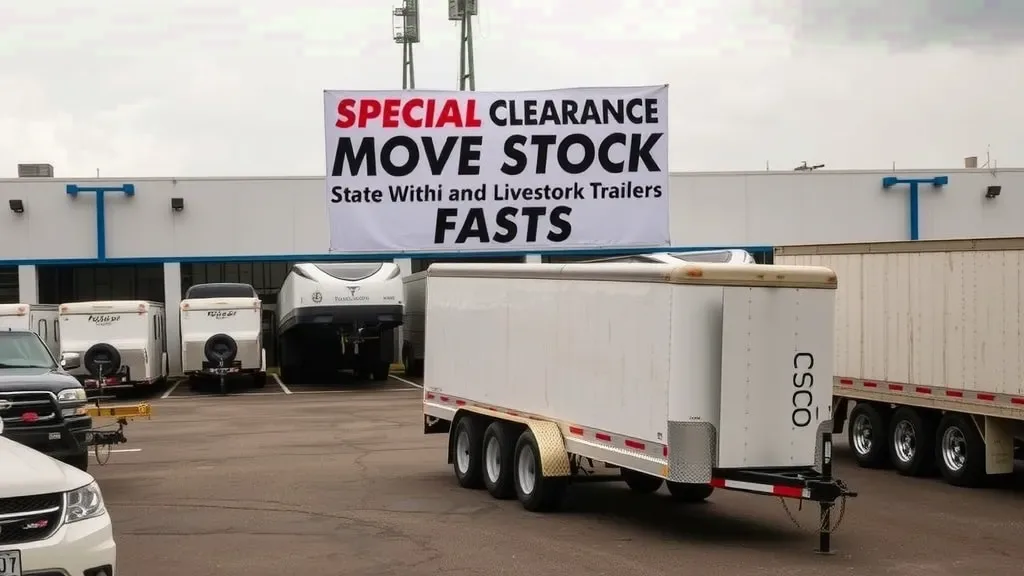
Even in August, regional demand spikes can be harvested. For example, the Midwest’s harvest season drives a temporary need for flatbeds to transport equipment. Dealers can launch a geo‑targeted SEO campaign using Trailer Shopper®’s built‑in SEO Dashboard, highlighting “Summer Flatbed Deals Near Me.” Pair this with a limited‑time banner or flag—printed on our in‑house promotional material—to capture roadside attention.
Leveraging Trailer Shopper® Technology to Execute the Plan
All of the tactics above are amplified when run through the Trailer Shopper® ecosystem. Here’s how the platform’s core features align with each lever:
- Inventory Management – Real‑time alerts when a trailer breaches the 30‑day or 60‑day thresholds.
- AI Video Commercials – Auto‑generate a 30‑second showcase for any flatbed or livestock unit, complete with dealer branding.
- Smart Messaging & Unified Inbox – Capture every lead from Facebook Marketplace, Instagram, or classified sites in one place, and let the AI Chat Assistant qualify prospects instantly.
- Ads and Social from One Dashboard – Deploy a coordinated ad burst across six networks with a single budget, tracking ROI in the Analytics Dashboard.
- White‑Label Blog & Portal – Publish a “Deal of the Week” post that automatically pulls the markdown price and bundles, boosting organic search traffic.
- Print & Promotional Services – Order custom banners, bow‑flags, and business cards that echo the online promotion, ensuring a consistent brand experience from digital to physical.
Because all data lives inside Trailer Shopper®, dealers avoid the costly duplication of effort that comes from juggling separate CRM, social‑media schedulers, and inventory sheets. One source of truth means faster decisions, lower overhead, and a tighter feedback loop.
Case Study: Turning a 90‑Day Flatbed into a 30‑Day Sale
"We had a 7‑by‑14 steel flatbed sitting for three months. By applying a 7% price cut, adding a free ramp, and launching an AI‑presented video across our social feeds, we closed the sale in 18 days and freed up space for a higher‑margin aluminum utility trailer," – Midwest dealer network manager.
This real‑world example underscores how a disciplined markdown schedule, combined with value‑add bundling and AI‑powered outreach, can reverse the stagnation curve.
Monitoring Progress and Adjusting Tactics
Dealers should treat inventory turnover as a living KPI. The Trailer Shopper® Analytics Dashboard provides:
- Average days on lot per category.
- Conversion rates before and after price adjustments.
- Lead source performance (social, marketplace, direct traffic).
When a flatbed’s Days‑On‑Lot metric drops below the 30‑day mark after a markdown, the system can automatically flag the unit as “ready for next‑level promotion,” prompting the dealer to consider upselling accessories or moving the unit into a premium “Featured” slot.
Bottom Line: Proactive, Data‑Driven Action Is the Only Way Forward
The August 2026 snapshot makes it clear: flatbeds and livestock trailers are the laggards in today’s market. Their longer new‑stock (60‑day) and used‑stock (90‑day) cycles expose dealers to higher financing costs and opportunity loss.
By embracing a three‑step framework—timely markdowns, strategic bundling, and AI‑enhanced outreach—dealers can shave weeks off the sales cycle, protect margins, and re‑stock with higher‑margin, in‑demand units such as aluminum utility trailers.
Remember, the tools are already in your hands. Trailer Shopper® AI can create a video in minutes, post it everywhere, and field responses automatically. Our in‑house print shop can deliver a banner in days, not weeks. Combine those capabilities with disciplined pricing, and the stale inventory problem becomes a short‑term challenge rather than a long‑term burden.
Stay vigilant, act quickly, and let the data guide every decision. The summer may be hot, but your inventory turnover doesn’t have to be sluggish.
— Trailer Shopper Intelligence Desk