Executive Summary
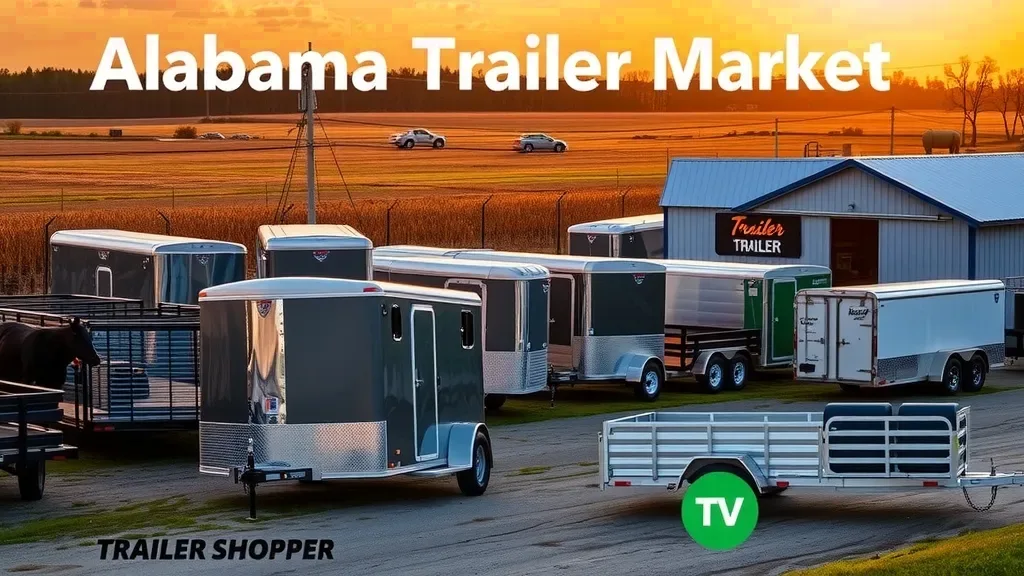
Our Alabama market intelligence shows a nuanced landscape where traditional work‑horse trailers remain the backbone of sales, while electric and telematics‑enabled units begin to carve out a niche. Average listing prices hover around $12,300 nationwide, with flatbed models averaging $12,178. Enclosed cargo trailers command a premium at roughly $3,800, reflecting strong demand from construction and recreation sectors across the state.
Regulatory shifts – notably the FMCSA’s proposed safety rule changes and updated FMVSS 136 stability‑control standards – are reshaping dealer compliance strategies. At the same time, macro‑economic indicators such as a 5% rise in freight volume and a 2.5% GDP growth rate are sustaining a moderate but steady demand for new trailers.
Dealers who leverage Trailer Shopper® and its AI‑driven suite – from AI Presenter video listings to unified inbox messaging – can capture the emerging opportunities while keeping costs under control.
Market Size & Economic Context
Alabama’s trailer market mirrors the broader Southern United States, where construction spending, freight movement, and a robust agricultural base drive demand. National construction spending sits at $1.4 trillion, freight volume is up 5%, and the unemployment rate remains low at 3.5%. Although inflation runs at 7.5% and interest rates sit near 4.5%, the combination of low unemployment and steady freight growth provides a supportive backdrop for trailer sales.
Within this environment, Alabama’s dealer community – part of the nation’s thousands of dealers on Trailer Shopper® – reports an inventory mix that leans heavily toward flatbeds and enclosed cargo units. The state’s industrial corridors, especially around Birmingham, Mobile, and Huntsville, see the highest concentration of construction and logistics activity, translating into a consistent flow of orders for both new and used units.
Top‑Selling Trailer Types
Our data categorizes Alabama’s sales by type, price range, and buyer intent:
- Flatbed Trailers – Still the most listed category, with an average price of $12,178. These units serve construction firms, landscaping businesses, and small‑scale freight operators.
- Enclosed Cargo Trailers – Average price $3,800. High demand from recreation (ATVs, boats), mobile workshops, and small‑business owners needing secure storage.
- Utility Trailers – Average price $1,800. Popular among hobbyists and agricultural producers for light‑duty hauling.
- Dump Trailers – Average price $4,800. Niche but growing in the state’s mining and road‑maintenance sectors.
While flatbeds dominate volume, the higher average price of enclosed cargo units yields a larger contribution to dealer revenue, aligning with the National Association of Trailer Manufacturers (NATM) finding that small‑to‑medium dealers generate roughly $1.5 million in annual revenue with margins of 10‑15%.
Pricing Dynamics & Competitive Landscape
Pricing in Alabama follows the national trend of market‑based markup strategies. Dealers typically apply a markup formula of Cost + (Desired Margin × Cost), with psychological pricing tactics such as ending prices in .99 to enhance perceived value. The average listing price of $12,296 reflects a competitive market where supply slightly exceeds demand for flatbeds, prompting dealers to consider markdown schedules every 30 days for inventory that lingers beyond 50‑70 days (new) or 80‑100 days (used).
Dealers who adopt Trailer Shopper® AI benefit from automated price optimization insights directly within the platform’s Analytics Dashboard. The system flags inventory approaching the 120‑day wholesale trigger, enabling proactive discounting or promotional bundling without manual spreadsheet crunching.
Demand Drivers Specific to Alabama
Construction & Infrastructure
Alabama’s ongoing highway expansion projects and a surge in private residential construction fuel flatbed demand. The state’s $1.4 trillion construction spend, combined with a 5% freight volume increase, translates into a steady pipeline of contracts that require reliable, heavy‑duty hauling solutions.
Agriculture & Rural Logistics
Utility and open trailers remain essential for farm equipment, feed, and livestock transport across the state’s extensive rural areas. The average utility trailer price of $1,800 makes these units an affordable option for small‑scale producers.
Recreation & Tourism
Alabama’s Gulf Coast and inland lakes attract boating, ATV, and camping enthusiasts. Enclosed cargo trailers, priced around $3,800, are the preferred choice for secure, weather‑proof transport of recreational gear.
Emerging Electric & Telematics Segments
Electric trailer sales now represent 5% of all new trailer sales nationwide, with a cost premium of roughly 10% higher than conventional units. While still a small slice of the Alabama market, the trend is accelerating – dealers report that 20% of new sales include telematics packages, offering real‑time location, load monitoring, and predictive maintenance data.
Dealers who have trained staff on electric and telematics models (currently 50% of the dealer base) are better positioned to capture this growth. Trailer Shopper® AI Presenter can generate video demos that highlight the silent operation and smart‑fleet benefits of electric trailers, driving buyer confidence without the need for a costly production crew.
Regulatory Landscape Impacting Alabama Dealers
Three key regulatory developments shape dealer operations in 2026:
- FMCSA Proposed Safety Changes (April 2026) – The agency is reviewing trailer safety standards to reduce accidents. Dealers should anticipate stricter inspection protocols and may need to upgrade older units to meet future compliance.
- FMVSS 136 Electronic Stability Control (effective Dec 2020) – All new trailers must be equipped with compliant electronic stability control systems. This requirement has become a baseline expectation for buyers, influencing purchasing decisions.
- DOT 49 CFR 571.108 Brake Standards (effective Oct 2020) – Updated brake system standards mandate higher performance thresholds. Dealers must verify that all inventory, especially used units, meets these criteria before listing.
In addition, the Federal Trade Commission’s Buyer’s Guide remains a mandatory disclosure for all trailer sales. Failure to display the guide prominently can result in compliance penalties.
Dealers using Trailer Shopper® can streamline compliance management through the platform’s Settings and Help modules, which provide up‑to‑date regulatory checklists and automated alerts when new standards are introduced.
Opportunities for Growth
Capitalizing on Electric Trailers
Although electric trailers currently account for only 5% of sales, the 10% cost premium is offset by lower operating expenses and growing buyer interest in sustainability. Dealers can differentiate by offering bundled charging solutions and financing options through our affiliate network (e.g., Sheffield Financial). Using Trailer Shopper® AI to create targeted video ads that showcase silent operation and zero‑emission benefits can accelerate adoption.
Telematics Integration Services
With 20% of new sales featuring telematics, there is a clear appetite for data‑driven fleet management. Dealers can partner with OEMs to provide installation and support services, positioning themselves as a one‑stop shop for smart‑fleet upgrades. The platform’s CRM Pipeline and Smart Messaging tools enable follow‑up campaigns that educate customers on the ROI of telematics.
Strategic Pricing & Inventory Turnover
Flatbed listings are experiencing a declining trend, indicating excess supply. Dealers should employ the platform’s Markdown Schedule automation to apply timed discounts after 30‑day intervals, while promoting higher‑margin enclosed units through AI Video Commercials. This approach balances inventory turnover with profit preservation.
Local Marketing & Print Collateral
Our in‑house print factories produce banners, business cards, bow flags, and apparel that can be customized for Alabama‑specific events – county fairs, construction expos, and agricultural shows. Combining physical branding with digital syndication via Trailer Shopper® AI ensures a cohesive, omnichannel presence.
How Trailer Shopper® Empowers Alabama Dealers
Our platform is built around a single source of truth: the dealer’s inventory, customer data, and marketing assets live on Trailer Shopper®. From there, the system syndicates listings to Facebook Marketplace, social networks, and classified sites with a single click – eliminating the need for multiple logins and manual uploads.
- AI Presenter creates personalized video walkthroughs for each trailer, boosting engagement without a production crew.
- Unified Inbox with AI Replies consolidates messages from all channels, allowing dealers to respond instantly and track lead status.
- Ads & Social from One Dashboard lets dealers launch campaigns across six ad networks, optimizing spend and reach.
- Analytics Dashboard provides real‑time insights on pricing performance, inventory age, and conversion rates.
- White‑Label Website & Blog give dealers a branded online storefront that ranks in local SEO, reinforcing the “live in days, not months” promise.
Combined with our print‑manufacturing capabilities, dealers can order custom banners, flyers, and apparel that match their digital branding, creating a seamless offline‑online experience for Alabama customers.
Strategic Recommendations for Alabama Dealers
- Audit Compliance: Use the platform’s compliance checklist to verify FMVSS 136 and DOT brake standards on every unit before listing.
- Prioritize Enclosed Cargo Units: Their higher average price and strong demand from recreation and construction make them a revenue driver.
- Introduce Electric & Telematics Options: Train staff (already done by 50% of dealers) and leverage AI Presenter videos to educate buyers.
- Implement Timed Markdown Schedules: Reduce aging inventory by applying automated discounts after 30‑day intervals.
- Leverage Local Print Assets: Deploy custom banners at regional trade shows and pair them with QR‑linked video listings generated by Trailer Shopper® AI.
- Utilize Unified Inbox & Smart Messaging: Respond to leads within minutes, increasing conversion rates in a market where buyer attention spans are short.
Looking Ahead: 2027 Outlook
Projections indicate that electric trailer adoption will reach mainstream levels by 2028, with a 15% market share. In Alabama, early adopters stand to capture a premium segment of environmentally conscious buyers, especially in the coastal tourism market. Telematics penetration is expected to climb to 35% of new sales, driven by fleet operators seeking efficiency gains.
Regulatory momentum suggests that FMCSA’s proposed safety changes may become final by late 2026, potentially introducing stricter load‑distribution and lighting requirements. Dealers who have already integrated compliance tools within Trailer Shopper® will adapt more quickly, preserving market share.
Conclusion
Alabama’s trailer market remains robust, anchored by flatbed and enclosed cargo demand, while nascent electric and telematics segments present high‑growth opportunities. Dealers who combine rigorous compliance, strategic pricing, and the full suite of Trailer Shopper® technologies – from AI‑generated video listings to unified lead management – will be best positioned to thrive in 2026 and beyond.
— Trailer Shopper Intelligence Desk